
Male Infertility Treatment
What is male infertility?
Reproduction (or making a baby) is a simple and natural experience for most couples. However, for some couples it is very difficult to conceive.
A man’s fertility generally relies on the quantity and quality of his sperm. If the number of sperm a man ejaculates is low or if the sperm are of a poor quality, it will be difficult, and sometimes impossible, for him to cause a pregnancy.
Male infertility is diagnosed when, after testing both partners, reproductive problems have been found in the male.
How common is male infertility?
Infertility is a widespread problem. For about one in five infertile couples the problem lies solely in the male partner.
It is estimated that one in 20 men has some kind of fertility problem with low numbers of sperm in his ejaculate. However, only about one in every 100 men has no sperm in his ejaculate.
What are the symptoms of male infertility?
In most cases, there are no obvious signs of infertility. Intercourse, erections and ejaculation will usually happen without difficulty. The quantity and appearance of the ejaculated semen generally appears normal to the naked eye.
Medical tests are needed to find out if a man is infertile.
What causes male infertility?
Male infertility is usually caused by problems that affect either sperm production or sperm transport. Through medical testing, the doctor may be able to find the cause of the problem.
About two-thirds of infertile men have a problem with making sperm in the testes. Either low numbers of sperm are made and/or the sperm that are made do not work properly.
Sperm transport problems are found in about one in every five infertile men, including men who have had a vasectomy but now wish to have more children. Blockages (often referred to as obstructions) in the tubes leading sperm away from the testes to the penis can cause a complete lack of sperm in the ejaculated semen.
Other less common causes of infertility include: sexual problems that affect whether semen is able to enter the woman’s vagina for fertilisation to take place (one in 100 infertile couples); low levels of hormones made in the pituitary gland that act on the testes (one in 100 infertile men); and sperm antibodies (found in one in 16 infertile men). In most men sperm antibodies will not affect the chance of a pregnancy but in some men sperm antibodies reduce fertility.
Sperm Production Problems
- Chromosomal or genetic causes
- Undescended testes (failure of the testes to descend at birth)
- Infections
- Torsion (twisting of the testis in scrotum)
- Varicocele (varicose veins of the testes)
- Medicines and chemicals
- Radiation damage
- Unknown cause
Blockage of Sperm Transport
- Infections
- Prostate-related problems
- Absence of vas deferens
- Vasectomy
Sexual Problems (Erection and Ejaculation Problems)
- Retrograde and premature ejaculation
- Failure of ejaculation
- Erectile dysfunction
- Infrequent intercourse
- Spinal cord injury
- Prostate surgery
- Damage to nerves
- Some medicines
Hormonal Problems
- Pituitary tumours
- Congenital lack of LH/FSH (pituitary problem from birth)
- Anabolic (androgenic) steroid abuse
Sperm Antibodies
- Vasectomy
- Injury or infection in the epididymis
- Unknown cause
The male reproductive system
The male reproductive system is made up of the testes, a system of ducts (tubes) and other glands that open into the ducts. The brain plays an important part in the control of the male reproductive system.
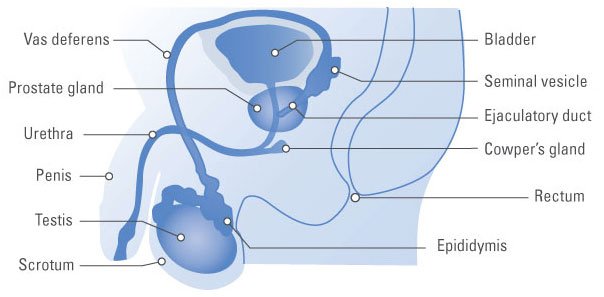
A side view showing the main parts of the male reproductive system
The pituitary gland and the hypothalamus, located at the base of the brain, control the production of male hormones and sperm. Luteinising hormone (LH) and follicle stimulating hormone (FSH) are the two important messenger hormones made by the pituitary gland that act on the testes.
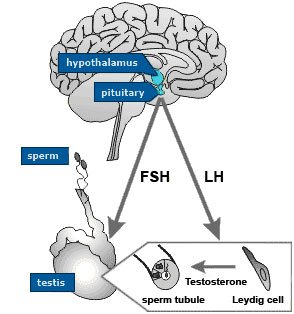
Two messenger hormones act on the testes
The testes (testis: singular) are a pair of egg-shaped glands that sit in the scrotum next to the base of the penis on the outside of the body. The testes make sperm and the male sex hormone testosterone. It takes about 70 days for sperm to become mature and able to fertilise an egg.
When released from the testes, the sperm spend two to 10 days passing through the epididymis where they gain the vital ability to swim strongly (become ‘motile’), and to attach to and penetrate (get into) the egg.
At orgasm, waves of muscle contractions transport the sperm, with a small amount of fluid, from the testes through to the vas deferens. The seminal vesicles and prostate contribute extra fluid to protect the sperm. This mixture of sperm and fluid (the semen) travels along the urethra to the tip of the penis where it is ejaculated (released).
16000+ Successful IVF Pregnancies in 30+ Years

Uttaranchal Test Tube Baby Centre
A unit of Prem Hospital & Research Centre
We offer the best services in fertility and reproductive medicine, state-of-art technology and advanced procedures in Uttarakhand.
CONTACT US
ADDRESS: Anaj Mandi, Near Main Kotwali Jwalapur Haridwar – 249407 Uttarakhand (INDIA)
MOBILE NO: +91 90450 90069 / +91 90450 50069
EMAIL: haridwarivf@gmail.com
WEBSITE: www.uttaranchalivf.com
Uttaranchal Test Tube Baby Centre | All Right Reserved. | Check Mail